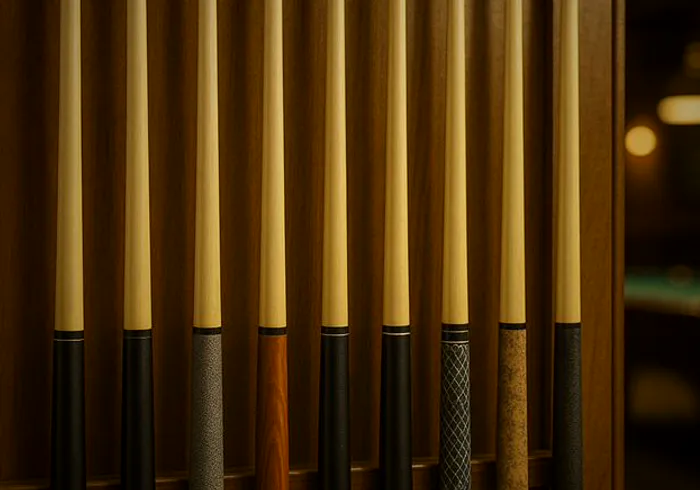
Best Pool Cues Under $200
The $100 to $200 range is the sweet spot for pool cues. Build quality jumps here, tips get better, and entry-level low-deflection shafts first show up. If you play regularly and want a cue you will still own in ten years, shop in this bracket.
Why this range is the sweet spot
Around $150 you stop paying for the bare minimum and start paying for real refinements. Tighter machining. Better-seasoned maple that stays straight. Upgraded pin and joint systems, and layered pigskin tips that hold their shape and their chalk better than pressed tips do. The jump in playability from a $60 cue to a $160 cue is large. From $160 to $500 it is much smaller for most players.
- Tips: expect a quality layered tip such as a Kamui-style or brand equivalent.
- Consistency: better wood selection means fewer warp and roll-out problems.
Low-deflection shafts start here
Deflection, or squirt, is how far the cue ball pushes offline when you strike it off-center for english. Low-deflection shafts cut it down with a lighter, stiffer end section, often hollowed or made of composite. Under $200 you can find entry low-deflection maple shafts plus a few carbon or fiberglass composite options. Aiming with spin gets more predictable, and that matters most for position play.
- Who benefits: players who use side spin regularly for shape.
- Trade-off: you retrain your aim once, and after that it gets easier for good.
Joints, pins, and feel
Joint design shapes how a cue feels at contact. A stainless-steel joint with a 3/8x10 or 5/16x18 pin hits firm and solid. Wood-to-wood joints sound softer and feed back more feel, which some players like better. Neither one is better. It is preference. What should not vary at this budget is the machining: clean, with no gap when the halves screw together.
- Firm hit: stainless or phenolic joint.
- Soft, feedback-heavy hit: wood-to-wood joint.
Weight, balance, and wrap
Most players settle between 18.5 and 20 ounces, with 19 the common default. Plenty of cues under $200 have a weight-bolt system, so you can move an ounce either way. The balance point should sit roughly 18 to 19 inches from the butt for a neutral feel. For the grip, Irish linen and leather both work well; leather handles sweat better in a warm room.
Our picks
Links open the current selection and price on Amazon so you can compare real reviews before buying.
Two-piece maple cue with layered leather tip, 19 oz
Best all-aroundA mid-tier cue from an established maker gets you a straight, seasoned shaft and a layered tip that holds up to daily play.
Check price on AmazonCue with entry low-deflection maple shaft
Position playersAn entry low-deflection shaft trims squirt on spin shots, so your aim holds truer when you use english for shape.
Check price on AmazonComposite-shaft cue package under $200
DurabilityA fiberglass or carbon-composite shaft resists warping and dings. Good pick if you travel with your cue or play in humid rooms.
Check price on AmazonFrequently asked questions
Is a low-deflection shaft worth it under $200?
If you use side spin often for position, yes. If you mostly hit center ball, a good standard maple shaft plays great and you keep the money.
Do more expensive cues make you play better?
Not directly. Above roughly $150 to $200 you are mostly buying looks, brand, and small differences in feel. Fundamentals matter far more than what the cue cost.
Should I get an adjustable-weight cue?
Nice to have, not essential. Weight bolts let you tune the feel by an ounce or so, and most players come to appreciate that once they develop a preference.
Related guides
LeaguePool is reader-supported. When you buy through links on this site we may earn an affiliate commission at no extra cost to you. As an Amazon Associate we earn from qualifying purchases.