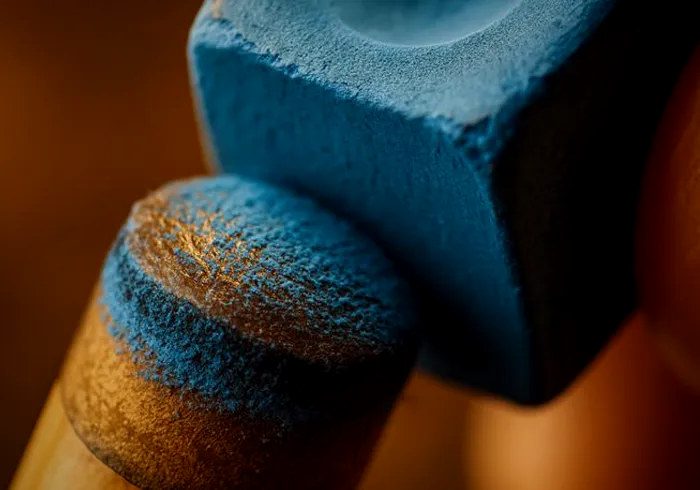
How to Chalk a Pool Cue Properly
Watch a room of casual players and you will see the same move over and over: cue jammed into the chalk cube, twisted like a pepper grinder, then set down with a hole bored through the middle. It feels productive. It is also the worst way to chalk a cue, and it quietly causes glazed tips, wasted chalk, and miscues that get blamed on everything else.
Good chalking takes no longer than bad chalking. The whole difference is in the motion and the coverage. Once you see why, the habit fixes itself in a session or two.
Brush, do not grind
Chalk works by leaving a layer of grit bonded to the texture on the tip's surface. Brushing light strokes of the cube across the tip lays that layer down evenly. Grinding does something else entirely. It burnishes the leather under pressure, polishing the surface smooth so chalk has less to hold onto. The player grinding hardest is making the tip hold chalk worse.
Hold the cue at a slight angle, sweep the chalk across the tip a few times, give the cue a quarter turn, sweep again. Three seconds, and it covers better than ten seconds of drilling.
If brushing feels unnatural at first, think of the chalk as the tool and the tip as the workpiece. You move the cube across the tip, or the tip across the cube face, in strokes. The one motion you retire is the twist. Within a week the brush is as automatic as the grind ever was, and your tips stop developing that shiny, chalk-shedding dome in the middle.
Cover edge to edge
You do not strike the center of the tip on most shots. Draw hits low on the tip, follow high, English out toward the edge. Those edge contacts are exactly where miscues happen, so they are the spots that most need chalk. A chalking habit that only coats the center is insurance that expires the moment you play spin.
Rotating the cue while you brush is the whole technique: crown and shoulders coated, no bare crescents. Glance at the tip afterward. It should look uniformly matte, with no shiny leather showing.
If chalk refuses to stick somewhere no matter how you brush, the problem is the tip and not the chalk. That spot has glazed. A couple of light passes with a scuffer restores the texture and the chalk holds again. Chalking habits and tip maintenance are two halves of the same miscue insurance.
How often to chalk
Every shot, in serious play. Chalk transfers to the cue ball on contact, so the coat you applied is partly gone after one hit. Watch any professional match: chalking between shots is as automatic as standing up.
- Minimum: every two to three shots, even on soft center-ball rolls.
- Always: before any draw, follow, side spin, or firm hit.
- Premium chalks: Taom and Kamui are built to bond in one light application and hold through several shots, which is much of what you are paying for. One coat, no re-grinding.
There is no penalty for chalking too often, only for chalking badly. A light brushed coat before every shot costs nothing and takes one variable out of every stroke, which is the kind of free consistency good players collect.
Keep it off the cloth and your hands
- Chalk away from the table so the falling dust lands on the floor instead of the cloth. Chalk ground into cloth wears it and marks the balls.
- Set the cube down face up. Face down leaves a blue ring on the rail every single time.
- Do not blow on the tip. It sprays dust and moisture around and takes off chalk you just applied.
- Use a holder or pocket case if you carry your own, so your hands and pockets stay clean between shots.
Reading your chalk cube
Your cube tells on your technique. A cube worn into a smooth, even dish across the whole face belongs to somebody chalking correctly. A deep round crater in the middle belongs to a grinder, and once that hole forms only the center of the tip gets coated, no matter how long the twisting goes on. If your cube has a crater, flip to a fresh face or edge and start brushing. A cube used properly wears down slowly and evenly, which is also why the brushers spend less on chalk than the grinders do.
Our picks
Links open the current selection and price on Amazon so you can compare real reviews before buying.
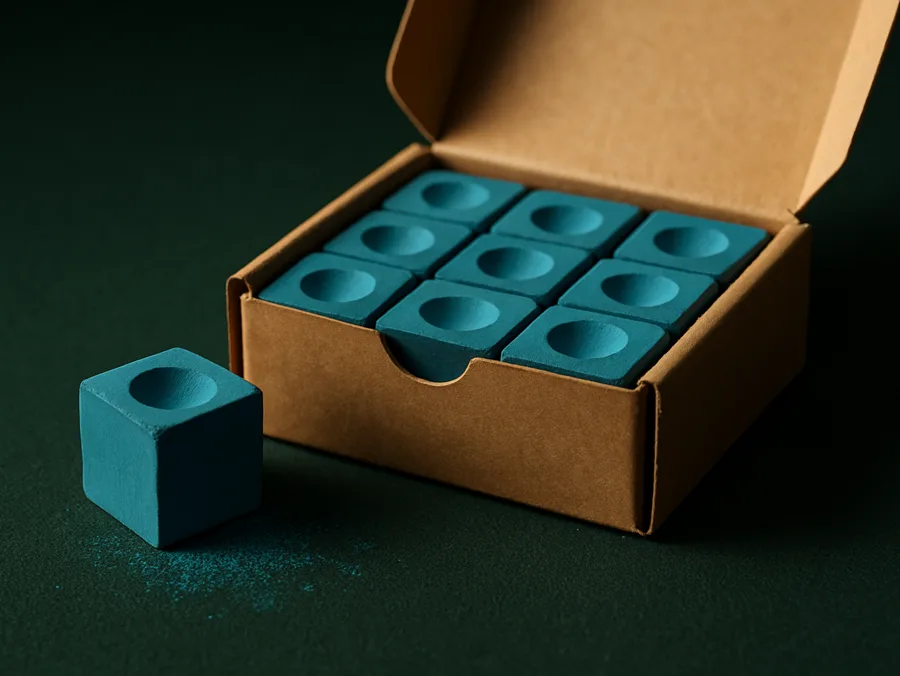
Master chalk box of 12
Everyday and league playThe standard cube on tables everywhere. A full box means fresh, un-cratered chalk for the whole season at pocket change apiece.
Check price on Amazon
Taom Pyro premium chalk
One-application coverageBonds in a single light coat and holds grip through several shots, with almost no dust and almost no marking on the cue ball.
Check price on AmazonMagnetic chalk holder
Keeping your chalk with youClips to your belt so your cube stays yours, stays face up, and never leaves a blue ring on the rail.
Check price on AmazonFrequently asked questions
Should I chalk before every shot?
In serious play, yes, since some chalk transfers to the cue ball on every hit. At absolute minimum chalk every two or three shots, and always freshly before any shot with draw, follow, or side spin.
Why is there a hole in the middle of my chalk?
That crater comes from grinding the cue into the cube and spinning it, which coats only the center of the tip and glazes the leather. Switch to brushing strokes across the tip while you rotate the cue, and the cube will wear evenly instead.
Does premium chalk really need only one application?
Largely, yes. Chalks like Taom and Kamui use finer particles and binders that bond to the tip and hold through several shots. You still want an even edge-to-edge coat, applied lightly once rather than reapplied constantly.
Related guides
LeaguePool is reader-supported. When you buy through links on this site we may earn an affiliate commission at no extra cost to you. As an Amazon Associate we earn from qualifying purchases.