Pool Table Slate: Thickness and 1 vs 3 Piece
Slate is the reason a good pool table plays true for decades. It is dense, it machines dead flat, and it does not care about humidity the way wood products do. But not all slate setups are equal, and two questions come up constantly when people shop: how thick should the slate be, and is one piece better than three? The thickness answer is straightforward. The one versus three piece answer surprises most buyers, because the cheaper-sounding option is actually the better one for a home.
Thickness: 3/4 versus 7/8 versus 1 inch
Slate on home tables comes in three common thicknesses. At 3/4 inch you get real slate performance at the lowest weight and cost, and it is common on entry-level 7 and 8 foot tables. At 7/8 inch you get a meaningful stiffness bump. At 1 inch you get the thickness the Billiard Congress of America specifies for tournament play, and it is what Diamond, Brunswick Gold Crown, and every serious table uses.
Thicker slate resists deflection between the frame supports, holds its machined flatness under the weight of years of play, and shrugs off the stress of refelting, where staples or glue and cloth tension pull at the edges. It also simply feels more solid; balls roll off the rails with a consistency thin slate cannot quite match. If the price gap is small, take the 1 inch.
Why three-piece slate wins for homes
Intuition says a single seamless slab must be flatter than three pieces with seams. In practice the opposite is true on a well-installed table. A one-piece slate can only be leveled as a unit, so any twist in the frame, sag in the floor, or warp in the slab itself is baked in. Three-piece slate lets an installer level each section independently with shims, then dress the two seams with wax or filler until a ball cannot find them. The result is routinely flatter than a one-piece install.
The moving argument is just as strong. A one-piece slate for an 8 foot table is a single slab in the neighborhood of 450 to 600 pounds that will not turn a stairway corner. Three-piece sections around 150 to 250 pounds each can be carried by two strong people. If a table might ever leave the room it was born in, three-piece is the only sane choice.
Where one-piece slate belongs
One-piece slate dominates coin-operated bar tables like Valley and Dynamo boxes, and for good reason. Those tables are moved as complete units on their sides in a truck, never disassembled, and the sealed one-piece design keeps the ball return mechanics aligned underneath. In that context the tradeoffs make sense. In a home, they mostly do not, though a used Valley bar box is still a legitimate budget path to slate pool if you have ground-floor access and a few strong friends.
Diamond-honed and slate origins
The phrase diamond-honed means the slate surface was ground flat with diamond abrasives at the factory, typically to tolerances of a few thousandths of an inch. Most reputable slate is honed; the term is worth confirming rather than being impressed by.
Origin matters less than marketing suggests. Italian slate from the Liguria region built the old reputation and is fine-grained and consistent. Brazilian slate is dense, hard, and arguably harder-wearing, and it backs many premium tables today. Chinese slate quality was once inconsistent but has improved, and it sits under most budget and mid-range tables now. A honed, properly framed piece of any of the three will play flat. A poorly supported piece of the finest Italian slate will not.
Weight, framing, and what it means for you
Thickness is weight. An 8 foot table with 1 inch three-piece slate carries roughly 600 to 750 pounds of stone, pushing the full table past 900 pounds. The same table in 3/4 inch slate saves 150 pounds or more. That weight demands a real frame, ideally with a center beam and cross supports under each slate seam, so when comparing tables look under the table, not just at the slate spec. Floors are rarely a problem; a table spreads its load across eight or more legs and sits well within residential floor ratings.
When you shop, the spec sheet tells you most of what you need in one line: three-piece 1 inch honed slate with a backed and cross-supported frame is the phrase that describes a table built to last generations. Everything below that is a negotiation between budget and longevity, and 3/4 inch three-piece slate remains a perfectly honest place to land.
Our picks
Links open the current selection and price on Amazon so you can compare real reviews before buying.
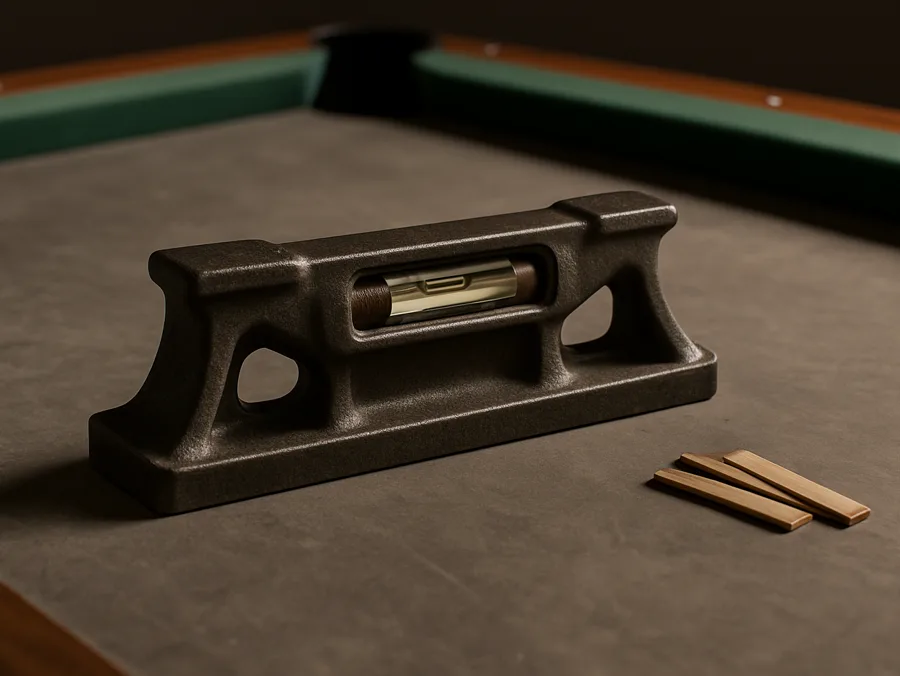
Machinist Level 12 Inch
Leveling slate properlyA carpenter level is not sensitive enough for slate work. A machinist level reads the small errors that make balls drift, and it is the tool installers actually use.
Check price on AmazonSlate Seam Wax Beeswax
Dressing three-piece seamsMelted beeswax is the traditional seam filler for three-piece slate. It fills the joint, sands flush, and comes back apart cleanly the next time the table moves.
Check price on AmazonComposite Table Shims
Fine slate adjustmentsThin composite or hardwood shims under the slate are how each piece gets dialed flat. Plastic composite will not compress over time the way cardboard scraps do.
Check price on AmazonFrequently asked questions
Is 3/4 inch slate good enough for a home pool table?
Yes, if it is properly supported by the frame and leveled well. It plays far better than any MDF table. That said, 1 inch slate stays flatter over the long haul and is the tournament standard, so take the thicker slate when the price difference is modest.
Can you feel the seams on a three-piece slate table?
Not on a properly installed one. The sections are leveled to each other and the seams are filled with wax or filler and dressed flush before the cloth goes on. Balls roll across a good seam with no deviation at all.
How much does pool table slate weigh?
Each piece of a three-piece 1 inch set for an 8 foot table runs roughly 200 to 250 pounds, or 600 to 750 pounds total. One-piece slates for bar tables run 400 to 600 pounds depending on size and thickness.
Related guides
LeaguePool is reader-supported. When you buy through links on this site we may earn an affiliate commission at no extra cost to you. As an Amazon Associate we earn from qualifying purchases.