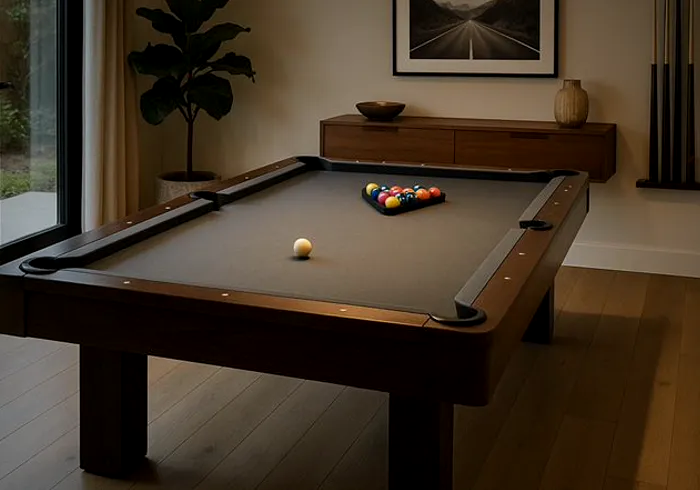
Can You Play Snooker on a Pool Table?
Full-size snooker is played on a 12-foot table with tight, rounded pockets, and almost nobody in America has one in the basement. The good news: you can play a genuinely satisfying version of snooker on an ordinary 7-foot or 8-foot pool table. The trick is not the table. It is buying balls scaled to it and marking a few spots, and suddenly the deepest cue sport there is fits in your game room.
Plenty of American players discovered snooker through late-night broadcasts of the World Championship and want to try it without importing a one-ton table. Here is exactly how to set it up, what translates, and what honestly does not.
Why Ball Size Is the Whole Trick
Regulation snooker balls are 2 1/16 inches, noticeably smaller than 2 1/4 inch pool balls, and a full snooker set is 22 balls: fifteen reds, six colors, and a cue ball. Cram 22 pool-sized balls onto a 7-foot table and there is no room to play; the geometry chokes. Ball makers solved this decades ago with reduced sets made specifically for American home tables.
A 2 1/8 inch set is the standard choice for 7-foot and 8-foot pool tables, close enough to pool ball size that the table pockets accept them naturally while restoring workable spacing. A 2 inch set suits 6-foot tables and gives even more open room on a 7-footer. Aramith makes both in proper snooker colors, and either transforms the game from cramped novelty into something that actually plays like snooker.
Marking the Baulk Line, the D, and the Spots
A snooker table has markings a pool table lacks: a baulk line across the table about one fifth of the way up from the bottom cushion, a semicircle called the D centered on that line, and spots for each color. On a 7-foot table, draw the baulk line roughly 15 inches from the bottom cushion and give the D a radius of about 5 to 6 inches; scale up slightly for an 8-footer. Precision matters less than consistency.
For the markings themselves, use what will not hurt the cloth: small adhesive table spot stickers for the six ball spots, and either a cloth-marking pencil or thin strips of crepe paper or removable tape for the baulk line and D. The colors go on their spots: yellow, green, and brown along the baulk line, blue at center table, pink between center and the rack area, and black near the foot rail. The reds rack in a triangle just behind the pink.
Scaled Rules: Snooker With 10 Reds
Play standard snooker rules, just with a smaller rack of reds. Ten reds is the sweet spot for a 7 or 8 foot table, and it has real-world legitimacy, since professional six-red and ten-red events exist. Alternate potting a red (1 point) with a color of your choice (2 through 7 points), colors re-spotting until the reds are gone, then clear the colors in order: yellow, green, brown, blue, pink, black.
Fouls award your opponent a minimum of 4 points, or the value of the ball involved if higher, exactly as on a full table. The maximum break with ten reds is 87 rather than 147. Everything that makes snooker addictive, the scoring decisions, the snookers themselves, the safety exchanges along the baulk colors, survives the scaling completely intact.
What Does Not Translate
Be honest about the differences so they do not surprise you. Pool pockets are wide and cut with directional angles, while snooker pockets are tight with rounded jaws, so potting on your pool table will be far more forgiving, especially along the rails. Long pots that would be heroic on a 12-footer are routine on a 7-footer. Pool cloth is also faster and more responsive to spin than napped snooker cloth, and the nap effects, where the ball drifts with the direction of the weave on slow shots, simply do not exist on worsted pool cloth.
None of this ruins the game. It just means your breaks will be bigger and your safeties easier to escape than real snooker. Treat it as its own game and it is superb practice: snooker's emphasis on precise cue ball control and thinking three balls ahead will quietly improve your pool.
Buying the Right Set
Match the ball size to the table: 2 1/8 inch for 7 and 8 foot pool tables, 2 inch for 6-foot and compact tables, and full 2 1/16 inch regulation only if you own an actual snooker table. Check that the set includes the full 22 balls even if you plan to rack only ten reds, since the spare reds cost nothing to keep. Phenolic resin sets from Aramith cost more than polyester import sets but hold their roundness and polish for decades, and on a small table where every ball sits close to traffic, true-rolling balls matter even more. Add spot stickers and a scoreboard and the total setup is one of the cheapest ways to add an entirely new game to a table you already own.
Our picks
Links open the current selection and price on Amazon so you can compare real reviews before buying.
Aramith 2 1/8 Inch Snooker Ball Set
Snooker on 7-8 ft tablesThe standard reduced set for American pool tables, with all 22 balls in phenolic resin that rolls true and fits home table pockets without crowding the playing surface.
Check price on AmazonAdhesive Pool Table Spot Stickers
Marking the six color spotsA sheet of low-tack cloth spots lets you mark the snooker spots and baulk positions accurately and peel them off later without leaving residue on the felt.
Check price on AmazonWall-Mount Snooker Scoreboard
Tracking breaks and framesSnooker scoring moves fast, with reds, colors, and foul points flying, and a traditional sliding scoreboard on the wall keeps frames honest without pausing play to do arithmetic.
Check price on AmazonFrequently asked questions
Can I just use regular pool balls to play snooker?
You can improvise with numbered balls standing in for colors, but 22 full-size pool balls badly crowd a 7-foot table and the game plays cramped. A 2 1/8 inch snooker set is the difference between a novelty and a real game.
How many reds should I use on a 7-foot table?
Ten reds is the widely used scaled version and it fits a 7 or 8 foot table well. Six reds works too and makes for quicker frames. With ten reds the maximum break is 87 instead of the famous 147.
Will the markings damage my table felt?
Not if you use the right materials. Adhesive spot stickers made for billiard cloth and a proper cloth-marking pencil or removable tape come off cleanly. Avoid regular pens, chalk lines, and heavy tapes, which can stain or lift fibers.
Related guides
LeaguePool is reader-supported. When you buy through links on this site we may earn an affiliate commission at no extra cost to you. As an Amazon Associate we earn from qualifying purchases.